

Hebei Mingxin Prefabricated Building Technology Co., Ltd. – (Reciprocating LC)
Tags:
Hebei Mingxin Prefabricated Building Technology Co., Ltd. (reciprocating LC ancillary supply) is a provider of intelligent solutions for component production scenarios offered by Xuelong Machinery. Leveraging nearly 20 years of experience in the R&D and manufacturing of prefabricated building-material equipment at Hebei Xuelong Machinery Manufacturing Co., Ltd., we provide end-to-end services—including custom design, installation, and operation & maintenance—for regional manufacturers of lightweight aggregate concrete (LC) components, helping to boost production efficiency and optimize overall costs in prefabricated construction.
Table of Contents
- The Core Application Value of Reciprocating LC Production Lines
- The Service Capability Endorsement of Hebei Mingxin Prefabricated Building Technology Co., Ltd.
- Comparison of Core Parameters and Configurations for Reciprocating LC Production Lines
- Standardized Implementation Process for the Deployment of a Reciprocating LC Production Line Project
- Project FAQs
I. Core Application Value of Reciprocating LC Production Lines
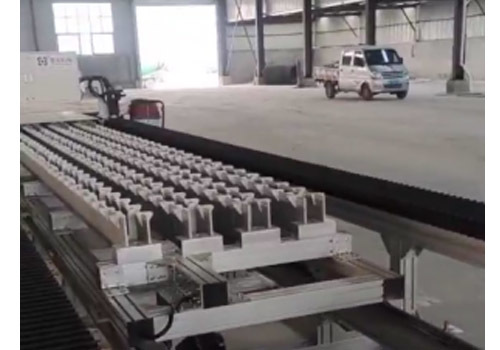
Reciprocating LC production lines are currently the mainstream intelligent equipment used in the prefabricated construction industry for manufacturing lightweight partition panels and concrete composite insulation components. Compared with traditional fixed-line systems, they enable simultaneous operations at multiple stations and eliminate lifting-related losses during process transitions, typically increasing single-shift capacity by more than 35% while reducing labor costs by approximately 40%. In recent years, as Hebei Province has advanced its prefabricated construction development plan, the share of newly built prefabricated projects in the region has steadily risen, driving year-on-year growth in demand for lightweight, high-strength, thermally insulating lightweight aggregate concrete (LC) components. Traditional fixed-line systems commonly suffer from drawbacks such as reliance on large cranes for material transfer, high damage rates due to formwork collisions, extensive manual labor requirements, and low site utilization—making it difficult for them to meet the cost-control needs of today’s component manufacturers. Reciprocating LC production lines employ a cyclic reciprocating drive system for formwork tables. Stations for material placement, vibration, curing, demolding, and stacking are arranged sequentially along the production flow, with formwork tables moving smoothly between stations via a rail-driven system, eliminating the need for frequent lifting and repositioning. This not only reduces capital expenditure on lifting equipment but also keeps component breakage and scrap rates at low levels. Moreover, these lines feature a compact layout and strong adaptability, allowing flexible adjustments to product types based on production needs, making them a cost-effective choice for medium-sized component plants seeking to upgrade their production capabilities.
II. Endorsement of Hebei Mingxin Prefabricated Building Technology Co., Ltd.’s Service Capabilities
Hebei Mingxin Prefabricated Construction Technology Co., Ltd., as the front-end service entity of Hebei Xuelong Machinery Manufacturing Co., Ltd. in the Hebei region, provides end-to-end services for reciprocating LC production lines—from conceptual design through delivery to operation and maintenance—and has served more than 60 component manufacturing projects in the region. Hebei Xuelong Machinery Manufacturing Co., Ltd. is one of the earliest domestic manufacturers engaged in the R&D and production of prefabricated construction equipment. Headquartered in Xingtai, Hebei, it operates an independent equipment R&D laboratory and a large-scale production workshop. Its core products include PC component production lines, lightweight partition panel production lines, and intelligent curing systems for precast components. The company has obtained over 30 technical patents, and its products are deployed in prefabricated component manufacturing across more than 20 provinces nationwide.
Hebei Mingxin Prefabricated Construction Technology Co., Ltd. – (Reciprocating LC) refers to a business segment that leverages Xuelong Machinery’s equipment manufacturing capabilities to provide comprehensive, end-to-end support for prefabricated lightweight aggregate concrete component manufacturers, offering complete reciprocating production line solutions. From early-stage feasibility studies and mid-stage equipment manufacturing and installation to later-stage production line operation and maintenance and capacity optimization, our services cover the entire lifecycle needs of manufacturing enterprises. We address the traditional pain point of production lines—emphasizing construction over operation—and help customers rapidly establish stable production capabilities for precast concrete components. At the service level, Mingxin Technology offers customized solutions tailored to each customer’s specific circumstances: we provide free on-site surveys of factory dimensions, power load, and existing equipment conditions, then use 3D modeling to deliver the most suitable production line layout; we dispatch experienced engineering teams to handle equipment installation and commissioning; we offer hands-on training for operators; and after delivery, we provide a one-year free warranty along with long-term spare parts supply and production line upgrade services, alleviating customers’ after-sales concerns.
III. Comparison of Core Parameters and Configurations for Reciprocating LC Production Lines
Reciprocating LC production lines with different configurations exhibit significant differences in capacity, capital investment, and applicable scenarios. Customers can select the appropriate configuration based on their capacity planning and product portfolio to avoid unnecessary expenditures. Based on actual operating data from reciprocating LC production line projects delivered by Hebei Xuelong Machinery Manufacturing Co., Ltd. over the past three years, a comparison of configuration parameters across various tiers is provided below:
| Configuration gear position | Single-shift capacity (8 hours) | Compatible Product Categories | Total Investment Range (in ten thousand yuan) | Core Adaptation Scenarios |
|---|---|---|---|---|
| Basic Manual Transmission | 120-150 cubic meters per shift | Ordinary lightweight partition board, 90–120 mm thick | 85-110 | County-level component manufacturers that are new to the industry and have low production capacity requirements |
| Semi-automatic transmission | 200-260 cubic meters/shift | Multi-thickness partition panels, composite insulated LC components | 140-180 | A regional medium-sized component factory with an established customer base that prioritizes cost-effectiveness. |
| Automatic transmission | 320-400 cubic meters/shift | Integrated components for irregular-shaped LC members and decorative finishes | 220-280 | Connecting with key engineering projects and leading component manufacturers with large production capacities |
Based on actual operational performance, for a given production capacity, a semi‑automatic reciprocating LC production line requires approximately 8 operators per shift, six fewer than a fixed‑type line of the same capacity, reducing labor costs by about RMB 20 per cubic meter of component. Moreover, since there is no lifting or impact during transfer operations, the scrap rate can be kept below 1.5%, representing a significant improvement over the roughly 4% average scrap rate of conventional lines.
IV. Standardized Implementation Process for the Reciprocating LC Production Line Project
A complete reciprocating LC production line takes approximately 45–60 days from initial requirements alignment to formal production launch. By implementing standardized milestone controls, the project timeline can be significantly shortened, enabling customers to start production sooner and capture market share more quickly.
- Requirements Assessment and Solution Design: The technical team conducts an on-site survey to measure the factory’s clear dimensions, power supply capacity, and overhead crane infrastructure. Based on the customer’s product portfolio and annual production capacity targets, they develop a preliminary plan that includes production line layout, workstation design, and an investment estimate, and provide feedback to the customer within three business days.
- Plan confirmation and contract signing: Optimize the proposal based on the client’s requested adjustments, clarify configuration standards for each module, the delivery schedule, and service terms; after both parties confirm all terms, sign the formal service contract.
- Equipment Manufacturing and Preparatory Work: Within 15 working days of contract signing, we will complete the production and machining of the core components for the production line. At the same time, we will assign dedicated personnel to guide the customer in carrying out preparatory tasks such as leveling the factory floor and connecting water and electricity services, thereby minimizing on-site construction waiting time.
- On-site installation and commissioning: The engineering team will be stationed on site to install the formwork platform, drive system, fabric‑laying equipment, and curing system. Equipment operating parameters will be adjusted station by station, with successful commissioning defined as eight consecutive hours of trouble-free trial production under load.
- Personnel Training and Formal Handover: Conduct a three-day hands-on training session for the customer’s operations and maintenance staff, covering equipment operation, routine maintenance, and troubleshooting of common faults. Upon successful assessment, the project will be formally handed over, and the warranty service period will commence.
This process is a standardized delivery framework refined by XueLong Machinery through hundreds of projects. Compared with the industry average project delivery cycle of 90 days, it can shorten construction time by nearly 40%, thereby reducing customers’ time costs.
V. Project FAQs
Regarding the reciprocating LC production line and the services provided by Hebei Mingxin Prefabricated Building Technology Co., Ltd., the following is a consolidated response to the key concerns commonly raised by customers:
- What are the core advantages of a reciprocating LC production line compared to a traditional fixed-line production line? The key advantage is that the sequence changeover requires no heavy lifting; the formwork platform moves smoothly between stations via a drive system, reducing both the investment in lifting equipment and scrap caused by component impacts. Additionally, the compact station layout reduces the floor space required by approximately 25% compared to fixed production lines, while maintaining the same production capacity.
- Can a reciprocating LC production line be installed if the factory building’s ceiling height is insufficient? Yes, the mold platform on the reciprocating LC production line is only 30–50 cm above the floor, and the maximum overall equipment height requirement does not exceed 4.5 m. For some older factories with a ceiling height of 3.8 m, installation can be achieved by adjusting the workstation layout, eliminating the need for large-scale structural modifications to the building.
- Can product categories be adjusted flexibly during the production process? Yes, the mold tables on the reciprocating production line use standard specifications. Without needing to replace dedicated molds, different thicknesses and strength grades of LC lightweight components can be produced by adjusting the material layer thickness and curing parameters, thereby meeting the customized requirements of various projects.
- Are the O&M costs high in the later stages of the production line? Based on operational data from delivered projects, the core drive components of reciprocating LC production lines can last over 10 years. Routine maintenance involves only periodic lubrication of the drive rails and cleaning away concrete residue from the fabric‑handling equipment, with annual maintenance costs amounting to approximately 2% of the total equipment investment—lower than the average maintenance costs of conventional production lines.
- Can Hebei Mingxin Prefabricated Building Technology Co., Ltd. provide capacity‑enhancement services after the production line is commissioned? Yes, after the warranty period following project delivery, we can provide services such as production line workstation optimization, automation module upgrades, and production process streamlining, based on the customer’s capacity‑enhancement needs, helping them further increase output and reduce costs using their existing equipment.
This article was generated by AI and is for reference only.


Copyright Information
Website Development:Enterprise Power Shijiazhuang| SEO|City Sub-stations
Contact Us
Address: Tianzhuang Development Zone, Xinji City, Shijiazhuang, Hebei Province (48.7 km along the Hengjing Line)
Phone:400-006-7803
Mobile phone:15803118880
WeChat:18633881383
Email:xuelongqiye@163.com

WeChat Official Account