

Zhuyou Jiaozhou Factory
Tags:
Zhuyou Jiaozhou Plant – PC Component Production Line: Equipment Implementation at a Key Node in Jiaodong’s Prefabricated Construction Capacity
Table of Contents
- Project Background: The industrial layout positioning of Zhuyou’s prefabricated construction facility in Jiaozhou
- Core Architecture of the Production Line
- Comparison of Key Technical Parameters and Production Efficiency
- End-to-End Implementation Steps for Production Line Deployment
- Supporting services for equipment manufactured by Hebei Xuelong Machinery
- Frequently Asked Questions (FAQ)
Against the backdrop of the construction industry’s dual-carbon transition and industrial upgrading, the level of intelligence in precast concrete (PC) component manufacturing equipment directly determines the supply efficiency and quality stability of prefabricated buildings. Zhuyou Jiaozhou Plant – PC Component Production Line It is a cluster of intelligent prefabricated concrete manufacturing equipment tailored to meet the supply needs of the Jiaodong Economic Circle’s prefabricated construction sector. As a manufacturer deeply rooted in the field of concrete prefabrication equipment, Hebei Xuelong Machinery Manufacturing has long provided customized production line design, fabrication, and installation services to various domestic prefabricated construction bases, participated in capacity‑building projects for numerous regional PC factories, and accumulated extensive experience in optimizing equipment for diverse industrial scenarios. This paper objectively outlines the actual operational logic and practical value of this production line, examining its project positioning, architectural composition, performance indicators, and implementation process.
1. Project Background: The industrial layout positioning of Zhuyou’s prefabricated construction facility in Jiaozhou
Zhuyou’s Jiaozhou factory serves as a core component-supply hub for a leading prefabricated construction company within the Jiaodong Economic Circle. The construction goals of its precast concrete (PC) component production line fully align with the prefabricated construction development plans of Shandong Province and Qingdao. According to the clear objectives set forth in the “14th Five-Year Plan for Prefabricated Construction Development” of Shandong Province, by 2025, prefabricated buildings should account for more than 30% of all new construction area across the province. As a demonstration city for prefabricated construction in Shandong, Qingdao is required to adopt prefabricated construction methods for 100% of newly built affordable housing and government-invested projects, corresponding to an annual market demand for PC components exceeding 3 million cubic meters. Previously, PC component supply in the Jiaodong region largely relied on production bases in Weifang, Yantai, and other areas. Industry consensus holds that the economically viable transport radius for PC components is approximately 150 kilometers; longer distances can cause transportation costs to exceed 20% of total procurement expenses, thereby increasing project construction costs and risking quality issues due to impacts or damage during transit. By establishing its PC production facility in Jiaozhou, Zhuyou aims to reduce the component supply radius to within 100 kilometers, covering project needs throughout Qingdao as well as eastern Weifang and northern Rizhao. The entire PC production line has a designed annual capacity of 120,000 cubic meters, sufficient to meet the component requirements of roughly 1 million square meters of prefabricated construction annually in the surrounding area. This effectively fills the gap in PC production capacity in the central and southern parts of the Jiaodong region, reducing overall construction costs for prefabricated projects in the area.
2. Core Architecture of the Production Line
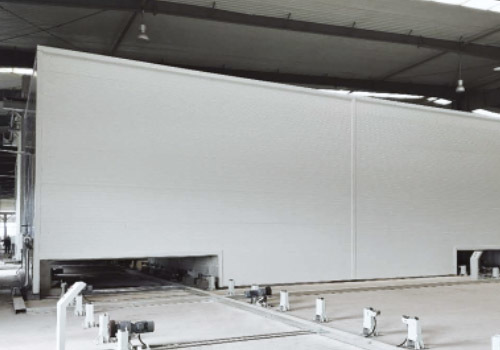
The PC component production line at Zhuyou’s Jiaozhou factory adopts a linear, modular, closed-loop architecture that covers every stage of production, from raw material input to finished‑product dispatch. Workstation configurations can be flexibly adjusted to suit product requirements. The entire line is divided into four core sections according to the production process. Roller conveyors enable automated transfer of mold platforms between sections, eliminating manual handling and reducing operator‑induced errors at the source. The first section handles mold platform cleaning and oiling: an automatic sweeping system removes residual concrete from the platform surface, followed by uniform application of release agent to prepare for subsequent mold installation. The second section involves mold installation and rebar tying: workers mount steel side molds on the platform according to component drawings, assemble the reinforcement cage, and secure embedded parts. The third section comprises concrete placing and vibration: an intelligent batching machine automatically feeds concrete based on component type, while a high‑frequency vibrator ensures thorough compaction and prevents quality issues such as honeycombing or rough surfaces. The fourth section manages curing and sorting: after vibration, mold platforms are conveyed via roller tracks into a temperature- and humidity‑controlled curing chamber. Once the concrete attains the required strength for demolding, a gantry crane lifts the finished components to the storage yard.
Zhuyou Jiaozhou Factory’s PC component production line is a customized, end-to-end automated production system designed for the prefabricated construction market on the Jiaodong Peninsula, covering the entire process from raw material input to the dispatch of finished components. The entire production line features an open‑architecture design, allowing flexible adjustment of workstation configurations to meet the component requirements of different projects—such as precast slabs, stairs, wall panels, and balcony slabs. This enables the line to accommodate multiple product types without extensive modifications to the underlying infrastructure, effectively reducing changeover costs. Compared with traditional fixed PC production lines, this architecture shortens mold‑table travel paths and minimizes idle equipment time. Should the plant later need to expand capacity, additional workstations can simply be added at both ends of the linear line without dismantling the existing equipment.
3. Comparison of Key Technical Parameters and Production Efficiency
The core performance indicators of the PC production line at Zhuyou’s Jiaozhou plant have reached an advanced domestic level for prefabricated PC manufacturing equipment, showing significant improvements over traditional lines in terms of capacity, yield rate, energy consumption, and land use. To provide a clearer picture of the production line’s operational efficiency, we conducted a horizontal comparison of parameters among a conventional fixed‑type line of similar scale, the industry average, and the Zhuyou Jiaozhou plant’s line; the specific data are as follows:
| Comparison Dimension | Traditional Fixed PC Production Line | Zhuyou Jiaozhou Factory’s Intelligent Precast Concrete Production Line | Industry average for production lines of similar scale in China |
|---|---|---|---|
| Design annual production capacity (10,000 cubic meters) | 6 | 12 | 8 |
| Complete cycle time for a single mold station (minutes) | 120 | 45 | 90 |
| Component Production Pass Rate (%) | 92 | 98.2 | 95 |
| Land area per unit capacity (square meters/10,000 cubic meters) | 1200 | 680 | 950 |
| Single-shift production staffing (persons) | 45 | 18 | 30 |
| Unit component production energy consumption (kg of standard coal/cubic meter) | 12.5 | 7.8 | 10.2 |
| Comparative data show that this intelligent production line doubles annual capacity from 60,000 to 120,000 cubic meters—without requiring additional floor space—by shortening the mold‑table cycle time. This means the same footprint can deliver twice the output. Moreover, thanks to a precision material‑distribution system and an automated excess‑material recovery unit, concrete waste has been reduced from over 5% on conventional lines to below 1.5%. Based on an annual capacity of 120,000 cubic meters and a C30 concrete price of RMB 400 per cubic meter, this translates into annual raw‑material cost savings of approximately RMB 1.8 million. The line’s integrated digital management system records in real time each component’s production batch, curing temperature, vibration time, and quality‑inspection results, establishing a seamless quality‑traceability chain from the shop floor to on‑site lifting operations and meeting the Ministry of Housing and Urban–Rural Development’s requirements for quality oversight of prefabricated construction. |
4. End-to-end implementation steps for production line deployment
The implementation of a precast concrete component production line is a systematic undertaking that must proceed step by step—through needs assessment, solution design, equipment installation, integrated commissioning and testing, and production‑readiness training—in order to ensure that the final operational performance meets the design objectives.
- During the initial requirements‑gathering phase, we collaborated with the client to map out three‑year demand for prefabricated construction projects within the service area, identify the core component types to be produced (e.g., composite slabs, interior and exterior wall panels, stairs, balconies), and calculate an appropriate production capacity. This enabled us to match the required line length and workstation count, thereby preventing both overcapacity and insufficient capacity. Given the Jiaozhou plant’s proximity to a port, we factored export‑oriented precast component production into our planning from the outset and allocated dedicated workstations for manufacturing large‑size components.
- During the design and feasibility study phase, taking into account the factory site’s geometry and floor load-bearing capacity, a layout plan for the production line will be finalized. Simultaneously, specialized assessments for fire safety, environmental protection, and energy consumption will be conducted to ensure full compliance with the relevant standards of the Technical Code for Prefabricated Concrete Structures JGJ 1-2014, thereby preventing delays in commissioning due to post‑construction rectification required for regulatory compliance.
- Equipment manufacturing and on-site installation phase: The core components—such as mold tables, concrete spreaders, curing kilns, and sorting equipment—are manufactured according to the design specifications and delivered to the site in batches for installation and commissioning. Simultaneously, electrical and control system wiring for the production line is completed to ensure seamless communication among all process sections and enable automated circulation control of the mold tables.
- Commissioning and production phase: First, conduct full-process no-load tests using simulated materials to identify installation accuracy errors. Then, gradually introduce actual concrete raw materials for small-batch trial production, adjusting material distribution accuracy, curing temperature and humidity parameters, and mold table transfer speed until the production yield and cycle time stabilize at the design targets.
- Personnel Training and Formal Production Phase: A two-week system training program will be conducted for the factory’s operations, maintenance, and quality inspection staff, covering equipment operating procedures, troubleshooting common faults, and component quality inspection standards. Mass production will commence only after successful completion of practical assessments.
5. Supporting Services Provided by Hebei Xuelong Machinery Manufacturing
As a specialized domestic manufacturer of PC component equipment, Hebei Xuelong Machinery Manufacturing provides comprehensive lifecycle support to various PC production bases—including the Zhuyou Jiaozhou plant—through customized equipment, responsive operations and maintenance, and long-term upgrades. First is our modular equipment design capability. The core components of PC production lines manufactured by Hebei Xuelong—such as mold tables, roller drive systems, and the main structure of concrete spreaders—are all designed using standardized, modular principles. Consequently, if a plant needs to expand or adjust its capacity mix, it can simply add the relevant functional modules without replacing existing equipment entirely, effectively reducing long-term capital expenditure. Second is our fully comprehensive O&M service network. We have established fixed service stations in major prefabricated construction industry clusters nationwide. For commissioned PC production line projects, we have implemented a 24-hour fault‑resolution mechanism: upon receiving feedback on equipment malfunctions, we provide actionable solutions within four hours, and dispatch technicians to the site within 24 hours for on‑site repairs, thereby minimizing production losses caused by downtime. Third is our ability to tailor customized solutions. We optimize production line layouts based on each plant’s site conditions and product positioning. For example, recognizing that the Jiaozhou plant handles export‑oriented component orders, we optimized the workstation configuration for large‑size wall panel production, meeting the demands of manufacturing oversized, irregularly shaped components.
6. Frequently Asked Questions (FAQ)
(1) Which regions primarily receive the PC components produced at Zhuyou’s Jiaozhou factory?
A: Based on the factory’s design service radius, it primarily serves prefabricated construction projects throughout Qingdao City, eastern Weifang, northern Rizhao, and other areas within the Jiaodong Economic Circle. It can also undertake interregional component supply services according to order requirements.
(2) What types of components can this PC production line manufacture?
A: The production line can be configured to manufacture standard precast concrete components such as composite floor slabs, precast interior and exterior wall panels, precast stairs, precast balcony slabs, and precast air-conditioning platforms. By adjusting the mold and platform configuration, it can also produce precast concrete components for municipal and landscaping applications.
(3) What is the approximate level of daily operational and maintenance costs for this type of intelligent PC production line?
A: Based on operational data from commissioned projects, the annual O&M costs for this type of intelligent PC production line—including consumable replacements and routine maintenance—account for approximately 3%–5% of the total equipment investment, significantly lower than the O&M cost share of traditional fixed-line production systems.
(4) When selecting a production line for a new precast concrete component factory, what core metrics should receive primary attention?
A: The core focus is on four aspects: first, the production line’s flexible adaptability—whether it can accommodate the manufacture of multiple component types; second, the stability of the production cycle—whether it can ensure uninterrupted continuous operation; third, the energy consumption per unit of output—whether it complies with dual-carbon policy requirements; and fourth, the responsiveness of after-sales maintenance services—aiming to minimize losses from equipment downtime.
(5) How can the production quality of precast concrete components be traced?
A: The digital management system integrated with the production line records, throughout the entire process, the concrete strength, curing time, and quality inspection results of each component, establishing a traceable quality archive that complies with the relevant requirements for quality supervision of prefabricated construction.
This article was generated by AI and is for reference only.


Copyright Information
Website Development:Enterprise Power Shijiazhuang| SEO|City Sub-stations
Contact Us
Address: Tianzhuang Development Zone, Xinji City, Shijiazhuang, Hebei Province (48.7 km along the Hengjing Line)
Phone:400-006-7803
Mobile phone:15803118880
WeChat:18633881383
Email:xuelongqiye@163.com

WeChat Official Account