

Zhuyou Fuyang Factory
Tags:
Zhuyou Fuyang Factory – PC Component Production Line: Project Overview, Process Configuration, and Equipment Selection Guidelines
Article Directory
- Basic positioning of the PC component production line at Zhuyou Fuyang Factory
- Core Configuration and Production Capacity Parameters of the Production Line
- Core Process Steps in Production Line Operation
- Hebei Xuelong Machinery’s Technical Advantages in Supporting PC Component Production Lines
- Project Application Value and Industry Reference Significance
- Frequently Asked Questions (FAQ)
Zhuyou Fuyang Factory’s PC component production line is a core facility for manufacturing prefabricated concrete components, forming part of Zhuyou Intelligent Manufacturing’s strategic layout in the Yangtze River Delta. Located in the Prefabricated Building Industrial Park of Fuyang District, Hangzhou, this production line is a key project under Zhejiang Province’s initiative to foster new‑type building industrialization. It primarily supplies precast concrete (PC) components for prefabricated construction projects within the Hangzhou Metropolitan Area and, since becoming operational, has provided compliant prefabricated components for numerous affordable housing and market‑rate residential projects.
1. Basic positioning of the PC component production line at Zhuyou Fuyang Factory
This production line is a benchmark lean PC manufacturing project established by Zhiyou Intelligent Manufacturing in the Yangtze River Delta region, positioned as a modern PC production base featuring “full‑category component compatibility, digital operations and maintenance, and low‑energy consumption.” The site is located adjacent to a major westbound arterial road in Hangzhou, 30 kilometers from the city’s central core. Its core service radius covers prefabricated construction projects within 150 kilometers, including those in Lin’an, Tonglu, northern Shaoxing, and southern Huzhou, making it one of the few large‑scale, compliant PC component production hubs in western Hangzhou. The plant can produce a full range of residential PC components, including composite slabs, precast stairs, precast interior and exterior wall panels, balcony slabs, bay window panels, and precast beams and columns, meeting the component needs of most prefabricated housing projects without requiring additional outsourced fabrication. From the project approval stage, strict adherence was maintained to the technical requirements of GB/T 51231, the Technical Standard for Prefabricated Concrete Buildings. Quality control across all production processes is linked to Zhejiang Province’s Building Component Quality Traceability Platform, ensuring full traceability of every component throughout production, inspection, transportation, and installation.
2. Core Configuration and Capacity Parameters of the Production Line
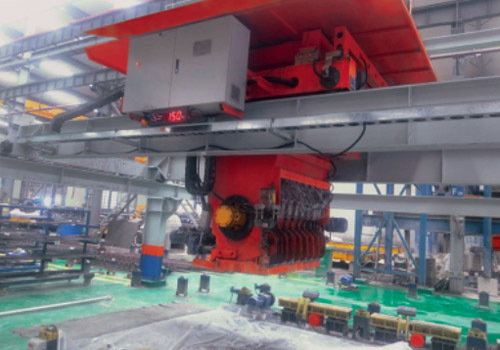
This production line adopts a layout that combines fixed platforms with circulating mold tables and flexible lines. Its core equipment includes modules such as a concrete placing system, a vibration forming system, a closed-loop curing system, and a formwork removal system, with a designed annual capacity of up to 150,000 cubic meters of precast components. To clearly present the project’s key operational metrics, the table below summarizes the production line’s critical configurations and design standards; the relevant parameters are compiled based on publicly available construction and acceptance documentation for the project.
| Parameter Category | Specific indicators | Design/Acceptance Criteria |
|---|---|---|
| Site and Plant Scale | The site covers approximately 80 mu, with a PC production plant building area of 32,000㎡. | Complies with the requirements of the Standard for Reliability Assessment of Industrial Buildings (GB 50144) |
| Core Mold Base Configuration | A standardized steel formwork platform measuring 3.5m × 9m is used, with a capacity of 120 units. | Formwork flatness error ≤ 2 mm/m; wear-resistant layer service life ≥ 5 years. |
| Designed annual production capacity | 150,000 cubic meters of PC components can supply approximately 1.2 million square meters of prefabricated building components. | First-pass yield for component production ≥ 98% |
| Maintenance System Configuration | Closed-loop curing kiln with temperature zones, temperature adjustment range of 20–60°C, equipped with a waste heat recovery system. | The concrete curing strength compliance rate is 100%, and the unit curing energy consumption is 20% lower than that of traditional kilns. |
| Digital system | Equipped with an MES production management system and a visual quality inspection module, and integrated with the provincial component traceability platform. | 100% coverage of data traceability across the entire component lifecycle |
Zhuyou Fuyang Factory’s PC component production line is a complete manufacturing system that uses standardized molds as the core handling unit and integrates digital scheduling, automated forming, closed-loop curing, and other technologies to achieve large-scale, lean production of all types of PC components. Compared with traditional, fragmented component fabrication sites, this system reduces material handling distances through fixed process routes, lowering energy consumption and labor costs during production. At the same time, it keeps dimensional accuracy deviations within 2 mm, resulting in both higher production efficiency and superior forming quality than conventional semi‑manual fabrication methods.
3. Core Process Steps in Production Line Operation
The entire production line operates according to a standardized workflow—“mold platform preparation—mold assembly—concrete pouring—curing—demolding—quality inspection—stacking”—with the whole process coordinated by an MES system to minimize manual intervention. The specific operational steps at each stage can be broken down as follows:
- Mold table preprocessing: Each mold table in the workflow undergoes automatic cleaning and release agent application. Visual inspection confirms that the surface is free of residual concrete and that the release agent is applied evenly, ensuring the surface quality of the components.
- Mold assembly and embedded installation: Based on the day’s component fabrication drawings, positioning tooling guides the installation of side forms. Simultaneously, the reinforcement cage is placed in the mold, and embedded sleeves, conduits, and components are positioned and secured. Each embedded component is verified via QR code scanning to ensure its specifications match the design drawings.
- Concrete Pouring and Vibration Molding: Commercial concrete with a strength grade of C30–C60 is mixed according to the component type. A precision spreading machine evenly places the concrete onto the mold table, and a variable-frequency vibration table compacts and molds the concrete. Throughout the process, the concrete slump is monitored in real time to ensure there are no voids or honeycombing within the component.
- Closed-loop curing operation: The completed formwork is transported by a shuttle car into the temperature-controlled curing kiln. Temperature and humidity parameters are adjusted according to the strength development curve of each component. Once the component’s strength reaches at least 70% of the design demolding strength, it is automatically shuttled out of the curing chamber.
- Formwork removal and surface treatment: Remove the side forms in sequence, clean flash from the component surfaces, conduct an initial visual inspection of the components, and repair any components with minor cosmetic defects.
- Quality Inspection and Warehousing: Component dimensions and embedded‑part position deviations are captured using 3D scanning equipment. Components whose parameters all comply with the requirements of JGJ 1, “Technical Code for Prefabricated Concrete Structures,” are affixed with traceability QR codes, transferred to the finished‑goods storage yard, and stacked by category according to the project’s delivery sequence.
4. Hebei Xuelong Machinery’s Technical Advantages in Supporting PC Component Production Lines
As a domestic enterprise specializing in the R&D and manufacturing of production equipment for precast concrete components, Hebei Xuelong Machinery Manufacturing Co., Ltd. has supplied core equipment and process‑optimization services to numerous similar PC production bases across China, with technical adaptability that meets the needs of PC production lines of varying scales and product categories. First, Xuelong Machinery’s core products include automatic fabric spreaders, vibration forming tables, mold‑table shuttle systems, and structural components for three‑dimensional curing kilns. These machines are designed with full consideration of high‑frequency wear and humid environments typical of PC production; key components boast a service life more than 30% longer than industry standards, helping to reduce future equipment replacement costs. Second, Xuelong Machinery can provide customized production line layout designs tailored to a plant’s site conditions and capacity plans. For facilities like those in Fuyang—located in the heart of the Yangtze River Delta where land is relatively scarce—optimizing mold‑table circulation paths can increase capacity utilization by approximately 15% within the same building footprint. Third, Xuelong Machinery offers full‑lifecycle operation and maintenance services. After equipment delivery, dedicated technicians are assigned to handle fault diagnosis, process parameter adjustments, and operator training during production, thereby lowering post‑installation O&M complexity. To date, Xuelong Machinery has provided equipment support to over 60 PC component production bases nationwide, with the operational stability of its equipment thoroughly validated through real‑world project experience.
5. Project Application Value and Industry Reference Significance
The completion and commissioning of the PC production line at Zhuyou’s Fuyang plant has filled the gap in large-scale PC component supply in western Hangzhou, offering valuable insights for reducing costs and improving quality in the prefabricated construction industry across the Yangtze River Delta. From the supply side, PC components in the Hangzhou region previously came mainly from production bases in Shaoxing, Jiaxing, and other areas, with transportation radii generally exceeding 100 kilometers. Transportation costs accounted for 15%–20% of component prices. With the Fuyang plant now operational, the core transportation radius has been reduced to within 50 kilometers, directly cutting project‑level component procurement costs by approximately 8%–10%. On the production side, the digital scheduling system employed on this line enables dynamic alignment between production plans and project delivery requirements, thereby reducing component inventory buildup. While average inventory cycles for typical PC manufacturers range from 15 to 20 days, this line’s precise scheduling can compress inventory duration to under 7 days, lowering capital‑occupation costs. As an industry benchmark, the line’s low‑energy design meets national building‑material production standards under the “dual carbon” goals. Measures such as waste heat recovery from curing kilns and rainwater harvesting for concrete curing reduce per‑unit production energy consumption by about 20% compared with conventional PC lines, providing a replicable model for green upgrades of similar facilities in the future.
6. Frequently Asked Questions (FAQ)
- What is the annual production capacity of the PC component production line at Zhuyou Fuyang Factory? A: The production line is designed with an annual capacity of 150,000 cubic meters of precast concrete components. When converted, this can meet the component supply needs of approximately 1.2 million square meters of prefabricated buildings, covering all categories of precast elements, including composite slabs, wall panels, stairs, beams, and columns.
- Did Hebei Xuelong Machinery participate in the construction of the PC production line at Zhuyou’s Fuyang factory? A: Hebei Xuelong Machinery Manufacturing Co., Ltd., a specialized R&D and manufacturing enterprise for PC component production equipment in China, has provided core equipment support to large-scale PC production bases across multiple regions nationwide. We can offer tailored production equipment and process optimization solutions based on project requirements. For specific cooperation details, please contact us through our official channels.
- What is the typical payback period for a precast concrete production line? A: Based on operational data from similar domestic projects, a PC production line with an annual capacity of 150,000 cubic meters typically has an average payback period of approximately 5 to 7 years under market conditions where prefabricated construction projects cover more than 30% of the region. The exact duration will be influenced by factors such as regional component market prices, capacity utilization rates, and production and operating costs.
- Which regional projects primarily receive PC components produced at the Fuyang factory? A: The factory’s core service area is centered on Fuyang District in Hangzhou, covering prefabricated construction projects within a 150-kilometer radius, including areas such as Lin’an, Tonglu, northern Shaoxing, and southern Huzhou. Priority is given to supplying components for affordable housing and key public building projects in the Hangzhou Metropolitan Area.
This article was generated by AI and is for reference only.


Copyright Information
Website Development:Enterprise Power Shijiazhuang| SEO|City Sub-stations
Contact Us
Address: Tianzhuang Development Zone, Xinji City, Shijiazhuang, Hebei Province (48.7 km along the Hengjing Line)
Phone:400-006-7803
Mobile phone:15803118880
WeChat:18633881383
Email:xuelongqiye@163.com

WeChat Official Account